 Fraunhofer Institute for Reliability and Microintegration IZM
More than a once-over – Reusable packaging for a more sustainable food industry
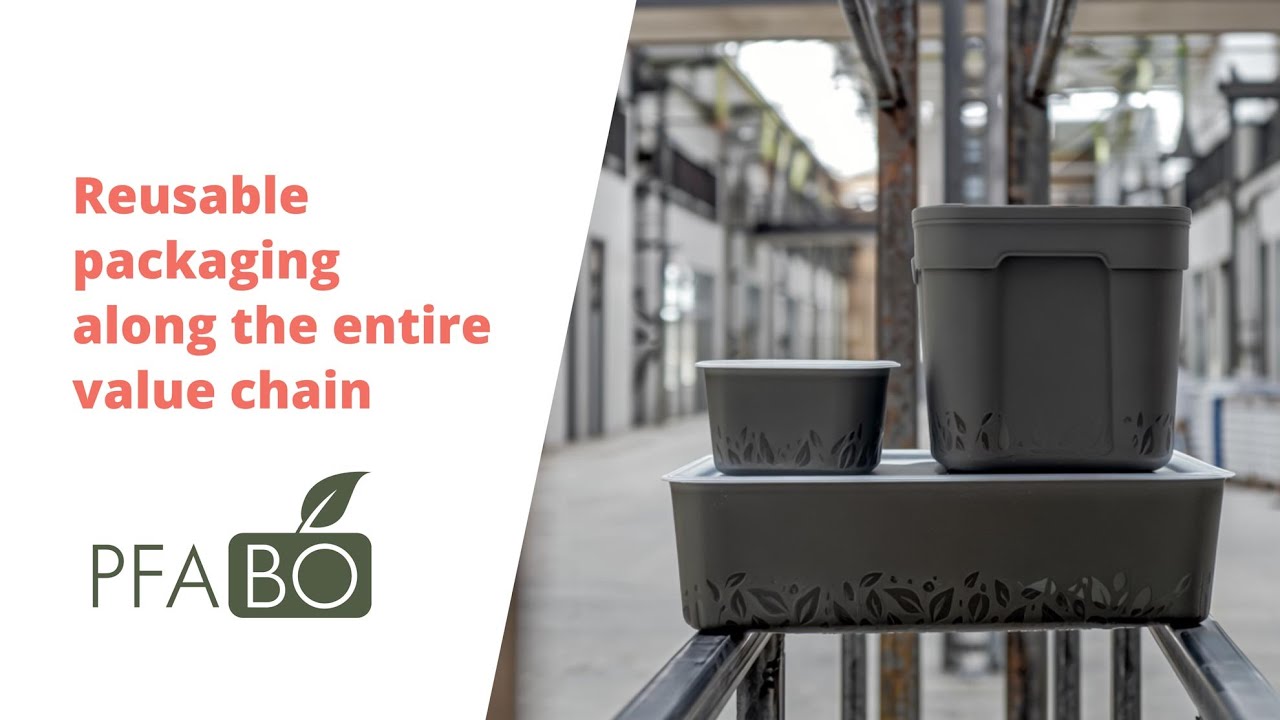
PFABO and its innovative deposit and returns system is taking sustainability to the next level in the food industry. Its founders, Juliane and Adrian Spieker, and their team have not only developed a new type of packaging, but invented a complete system for reusable packaging that covers production, logistics, cleaning, and digital tracing. Their mission: To drastically reduce the amount of one-way packaging in the food industry and establish reusable packaging as the new normal. With the team at Start-A-Factory, which brings hardware startup entrepreneurs and researchers together at Fraunhofer IZM, the PFABO containers are made fit for the hygiene standards of the food industry - all thanks to an AI-driven monitoring system.


What made you interested in reusable packaging and the idea of a circular economy in the first place?
Juliane: Packaging is there for a reason. It protects our products, keeps it safe during shipping, and makes them last longer. But over time, we have become prey to a type of packaging mania: Lots of items are packaged not once, but twice or even three times, even if that gives you no added protection at all. As a consumer, you usually get to experience this after shopping: You get back home, and the first thing you do is that you throw lots of packaging in the trash. This is where the flood of packaging becomes visible for most of us. In industry, however, it is far worse, but generally invisible and unseen to consumers. Producers would, for instance, package delicatessen or salads for shipping, that then get unpacked and the original packaging gets thrown out. An immense effort for something that is sometimes only used for a couple of hours. So we thought: There has to be another way.
We have a clear mission: PFABO is meant to get us away from linear thinking, where packaging can only be used once, and in the direction of a real circular system. To put it in plain English: We want to turn reusable packaging from a niche idea into the general standard. To do that, we are going right to the actual companies and helping them change their thinking from „I chuck everything“ to „I will keep this, return it, and reuse it.“
Was there any key moment, a key realization that made you think: If we want this, we need to do it ourselves?
Juliane: Several, actually. I originally come from a different field, from corporate consulting. As one of my jobs, I advised hospitals with a top role in marketing. But then I started to think: „How meaningful is my work?“ As a mother of two, I began to rethink my consumption habits. It wasn't just a question of what I was buying, but also how food actually got to the table. At the same time, there were several studies that showed how packaging has exploded over the past decades, and they made me think. So I sat down with my brother Adrian and we thought about how we could do it differently. From those conversations, we eventually arrived at PFABO. One study that really pushed my belief in our idea was the research conducted by the Fraunhofer Cluster of Excellence Circular Plastics Economy CCPE on plastic-based reusable systems in a circular economy. That study showed that reusable concepts would be a very effective way to tackle the problem of the increasing flood of packaging of the last few decades.
Adrian is a mechanical engineer and product developer by training, and he included the idea for PFABO in his Master’s research, putting down the basic technical concepts. We also reached out to potential partners, which is what brought us to Fraunhofer IZM. This is where we met Alexandra Rydz and Ulf Oestermann at Start-A-factory, and the two just spontaneously invited us to join them for a workshop. We then bounced our ideas for cooperation with the different parts of the Institute off each other. But then the first lockdown hit and everything came to a standstill. Luckily, the project survived, and we stayed in contact with Fraunhofer IZM. The EXIST founders’ fund allowed us to continue our work and make it more professional.
In the end, we won a major R&D project from the Federal Ministry of Agriculture, Food and Regional Identity, and we got Fraunhofer IZM on board as an affiliate Alexandra and Ulf continued to support us like before the lockdown, and the cooperation with Start-A-Factory meant that we could start our journey on the way to making a prototype. Start-A-Factory is a really unique concept in our science landscape for R&D teams with a focus on hardware. It meant that we could work with science specialists, cutting-edge facilities, and more contacts into the field and turn our first vision of our product into a professional prototype in record time.
Was there any knowhow that was critical for developing your product?
Juliane: When you talk about a circular system, you need to keep so many issues in mind, especially when you want to roll things out on a big scale. With hundreds of thousands or even more pieces of packaging out in the world, it is simply impossible to check every container manually. This meant that it was clear from the get-go that we needed to automate the quality monitoring. And this is where Fraunhofer IZM came in with its experience. Carsten Brockmann and Christian Tschoban from the RF & Smart Sensor Systems helped us think about which parameters we need to monitor and how sensors could be used to identify damaged or soiled packaging reliably.
What we wanted was a system that worked perfectly hygienically, but stayed economically viable. The researchers at Fraunhofer IZM suggested sensor technology that we adapted for PFABO. At its heart, there is an AI-based monitoring system which makes the machine „learn“ to recognize certain surface properties or discolorations and to draw certain conclusions from that about possible contamination. Developing this sensor system was a great leap ahead for us, because it lets us make sure that any packaging that is returned into the cycle will live up to the same hygiene requirements as regular one-way packaging - but with far less waste, because our containers can be reused 250, even five hundred times.
Why don’t we follow one of your containers through its life, from its production to its use, and then on to cleaning and recycling...
Juliane: It all starts at our production partner, Adoma GmbH in Germany’s Allgäu region. They use injection moulding to make our containers, which can vary from 0.25 to 5.4l in size. During production, an in-mold label is integrated, which is important for digital tracing later on. From there, the containers are cleaned for the first time and delivered to food producers or retailers. They fill the containers, e.g. with salads, desserts, or other convenience food products. Depending on the chosen use, they might go to wholesale or to actual retailers, where the produce is taken out, processed, and sold on to the consumer.
Another client we deliver to us are the Vivantes hospitals of Berlin. A few years ago, they switched everything in their take-away products to reusable packaging, which is a positive model for how a company can make this the new normal if they just commit to it completely. We calculated that this saved around 620,000 one-way cups for Vivantes per year. In this case, Vivantes actually cleans the cups and containers themselves and returns them back to the cycle. In more conventional delivery setups (production to distribution), the containers would be collected and sent to a central cleaning service like Cup&More. That is where they would pass the crucial quality checks. With the sensors we developed with Fraunhofer IZM, every container or bucket is reliably screened, and only the items that pass these tests will be released back for reuse.
Vivantes was one of your success stories, but would you say that reusable packaging has already become common practice? What are the main challenges that remain?
Juliane: One definite challenge is the mindset. Companies have spent decades on building structures and establishing processes. When you then come in and interfere with those, you get friction. Different teams need to work more closely with each other, responsibilities might shift. It will not work without a clear signal from above: This is how we do it from now on. A while ago, it became mandatory for companies to offer reusable options for take-away, but this is not yet the case in many instances. This shows how ingrained the old ways are. Apart from us - and we are working in the B2B area, which is where we see the greatest impact - there are some other actors offering similar solutions in the business-to-consumer field. You might have seen supermarkets offering reusable containers in their fresh produce sections, or take-away restaurants. Or maybe dairy products in glass containers. But all in all, the onus is still on the retail customer to get reusable containers. Clear and committed action is needed now and going forward, or this will not work.
But there are technical challenges still, as well. Every new piece of packaging goes through a long development cycle: from the first sketch to a 3D print, to testing, tooling, changes and refinements, filling and cleaning tests. Every detail counts, be it the thickness of the material, the lids and seals, or the filling capacity. At PFABO, we are an experienced team with good project management, which means that these technical development cycles run quite smoothly with us.
It’s great that Start-a-Factory brought you here, and we’re excited to see what the future has in store for PFABO - where can you see yourself heading in the next few years?
Juliane: Our goal and mission has not changed: To get reusable containers out of their niche and into everyday reality for industry. Or even more: To make them the standard for primary packaging in the food industry, period. This is why we keep improving on our technology and helping companies make the change. At the same time, it is about strengthening our networks. We need science, industry, and politics on board, because innovation alone will not be enough. Clear legal requirements are just as important. As a founding partner and former member of the board of the German Association for Reusable Packaging, one of my personal hopes is that we believers in reusable ideas will move more in the direction of standardization and professionalization. We are constantly advocating for the idea of reusable packaging at public events and conferences.
I am not expecting a 180 degree turnaround in six months. However, if we maintain our stamina and continue to move forward step by step, we will come a long way. This needs companies with courage, technical innovation, users and consumers who are ready to get on board, and a political environment that gives us the legal framework we need. With this, we can move towards a reusable normality - that is what we are working for.
(Interview: Lotta Jahnke)
Privacy warning
With the click on the play button an external video from www.youtube.com is loaded and started. Your data is possible transferred and stored to third party. Do not start the video if you disagree. Find more about the youtube privacy statement under the following link: https://policies.google.com/privacyAbout Start-A-Factory:
Start-A-Factory helps start-ups and SMEs move from first ideas to professional prototypes - fast, with cutting-edge facilities and a network of Fraunhofer IZM researchers and other partners and supporters. The development team stays involved with the right intensity of professional support for each case. The necessary effort and timescale is defined to match each project: Based on a first workshop, we work with the R&D team to find the right roadmap and tailor each solution to their needs. Start-A-Factory brings developers and support or cooperation partners together - creating the perfect conditions for successful product development. Trust is our best asset, which is why Start-A-Factory never takes a share in our client’s business: The intellectual property stays with the people developing their idea. 100% of it.
More information: www.start-a-factory.com
About PFABO:
PFABO GmbH develops premium reusable packaging solutions for the food industry. As a comprehensive system provider, PFABO takes care of cleaning, logistics, and the IT infrastructure for a transparent circular system – Packaging as a Service. Since its foundation in 2020, PFABO has been committed to innovative and sustainable solutions to reduce packaging waste and fulfill legal standards.
The vision of PFABO is to revolutionize the food industry with sustainable reusable packaging and contribute to a world with less waste. PFABO stands for innovation, quality, and transformation and sets new standards in the packaging industry. Working with its clients, PFABO is building a more sustainable and economically positive future.
More information: https://pfabo.de

Last modified: